




 McDonald" />
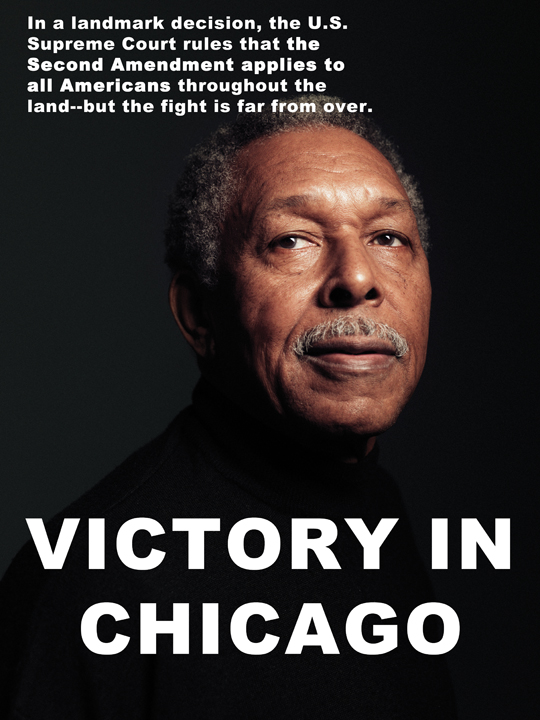
On June 28, 2010--two years and two days after declaring that the Second Amendment protects an individual right to possess handguns for self-defense--the Supreme Court of the United States declared just as clearly that the Second Amendment protects that right not just in Washington, D.C., and federal enclaves, but in every state, city and town in America. The decision is a great victory for gun owners--but also highlights the need for us to keep being politically active, now and forever.
The ruling came in the case of McDonald v. City of Chicago, a challenge to handgun bans in Chicago and Oak Park, Ill. The plaintiffs in the case were Chicago residents who wanted to keep handguns in their homes for self-defense, but couldn’t do so under the city’s nearly 30-year-old handgun ban. McDonald and a similar case brought by NRA were consolidated in the Seventh Circuit U.S. Court of Appeals. The Supreme Court made NRA a party to McDonald when it decided to hear the appeal.
In an opinion by Justice Samuel Alito, the Court announced: “We have previously held that most of the provisions of the Bill of Rights apply with full force to both the Federal Government and the States. Applying the standard that is well established in our case law, we hold that the Second Amendment right is fully applicable to the States.”
Joining Justice Alito were Chief Justice John Roberts and Justices Anthony Kennedy, Antonin Scalia and Clarence Thomas. These five justices also made up the majority in District of Columbia v. Heller (2008), in which the Court ruled that the Second Amendment protects a pre-existing, individual Right to Keep and Bear Arms and struck down D.C.’s bans on handguns and operable firearms in the home. Dissenting in McDonald were Justices Stephen Breyer, Ruth Bader Ginsburg and John Paul Stevens, all of whom dissented in Heller, and Justice Sonia Sotomayor, appointed to the Court last year by President Barack Obama.
|
WHAT’S THE NEXT BIG CASE? NRA will follow up the win in McDonald with more legal challenges to ensure that anti-gun politicians and judges don’t turn this latest victory into a practical defeat. Right now, no one knows what case will be the next milestone in the history of the Second Amendment. It’s a sure bet that hundreds of cases will come up in the next few years. NRA will work on future cases to advance the Second Amendment as quickly and effectively as possible. Some cases we’ll bring directly. Others we’ll support with briefs and research. Even more cases will be launched by other groups or individuals. Some of these cases will advance freedom. Others, unfortunately, will have little chance of success and a good chance of making bad law. Your NRA will be fighting in courts across the country to make sure our rights are defended and respected. None of our litigation strategy will work, though, without your involvement and support. If you are aware of an ongoing or potential case that might deserve our attention, please e-mail NRA-ILA’s Office of Legislative Counsel at [email protected]. |
In McDonald, the Court applied the Second Amendment to states and cities through the 14th Amendment’s Due Process Clause, an argument that former Solicitor General Paul Clement primarily relied on during his oral argument on behalf of NRA. (Justice Thomas also filed a separate opinion arguing that “... the Right to Keep and Bear Arms is a privilege of American citizenship that applies to the States through the 14th Amendment’s Privileges or Immunities Clause.”) The point was also emphasized in NRA’s briefs authored by Second Amendment scholar Stephen P. Halbrook and attorney Stephen D. Poss of the firm Goodwin Procter LLP, which has donated more than 1 million dollars’ worth of its lawyers’ time to Second Amendment litigation.
Under longstanding Supreme Court case law, a right is protected under the Due Process Clause if it is “fundamental” and “deeply rooted in this Nation’s history and tradition.” Looking back to the Heller decision, the Court found that the Right to Keep and Bear Arms easily met both standards. Not only has self-defense been recognized as a basic right since ancient times, but the Right to Keep and Bear Arms was recognized in England and America long before our country existed.
The Court went on to explain that the Right to Keep and Bear Arms was also clearly recognized when the 14th Amendment was adopted to protect the freedmen after the Civil War. 14th Amendment supporters were strong advocates of an armed citizenry. As one House member put it at the time, “Disarm a community and you rob them of the means of defending life. Take away their weapons of defense and you take away the inalienable right of defending liberty.”
The Court completely rejected every argument made by Chicago and its cohorts, as well as those made in the dissenting opinions by Justice Breyer (joined by Justices Ginsburg and Sotomayor) and by Justice Stevens (for himself alone).
First, the Court rejected Chicago’s arguments, including its attempt to rely on foreign law. A right is protected if it is fundamental in our history and tradition--not those of a foreign country. Gun bans and other restrictive laws in England, Australia or Luxembourg can’t be used to undermine the rights of Americans. Further rebuking Chicago, the Court said a right must be protected even if it has “controversial public safety implications” or might lead to “extensive and costly litigation.”
|
DEFYING THE COURT: NRA BACKS LEGAL CHALLENGE TO NEW CHICAGO LAW WITHIN DAYS OF the McDonald decision, Mayor Daley and the Chicago City Council enacted the most restrictive anti-gun ordinance in the United States. Mara Georges, the top attorney for the city, admitted, “We’ve gone farther than anyone else ever has.” In response, one of NRA’s longtime outside attorneys, former U.S. Assistant Attorney General Charles J. Cooper, filed an NRA-supported challenge to many of the worst provisions of the new law. Chicago’s so-called “Responsible Gun Ownership Ordinance” is modeled to a large degree on the law the District of Columbia Council enacted to thumb its nose at the Supreme Court’s Heller decision. Chicago’s new ordinance generally bans the possession of a firearm anywhere outside the immediate interior of a home (even in an attached garage), bans the possession of more than one assembled firearm within the home, bans the transfer of any firearm except by inheritance, allows the police superintendent to arbitrarily ban particular handguns as “unsafe,” bans adults between ages 18 and 20 from possessing firearms without the permission of a parent or guardian, imposes severe gun registration provisions, generally prohibits the operation of shooting ranges, requires five hours of training to obtain a permit to merely possess a firearm at home, and prohibits the possession of laser sights, which more and more gun owners are adopting for use in self-defense. Challenging these provisions are a number of gun owners and would-be gun owners in Chicago, along with the Illinois Association of Firearms Retailers--a trade association whose members would open gun stores and shooting ranges in the city, if not for the restrictive new law. Trying to put a positive spin on the Heller and McDonald rulings, gun control supporters have claimed that even though each ruling recognized an individual Right to Keep and Bear Arms for self-defense, each also gave a green light to all manner of gun control short of a total ban. In their view, that would include measures such as Chicago’s new law, which are designed to eliminate or discourage firearm ownership by making it unreasonably difficult and expensive. Of course, Heller did not strike down D.C.’s explicit handgun ban just to give the court’s blessing to de facto gun bans in other forms. The Court did say it would likely be constitutional to have “laws forbidding the carrying of firearms in sensitive places such as schools and government buildings, or laws imposing conditions and qualifications on the commercial sale of arms.” But clearly, the Court’s language did not approve laws prohibiting the carrying of firearms in a homeowner’s garage, or prohibiting “commercial sales of arms” altogether. It comes as no surprise that Daley is more interested in limiting gun ownership than in complying with the decision of our nation’s highest court. After the McDonald ruling was handed down, Daley said, “Too many people can easily obtain guns in America . . . ,” and that he and others who share his view should campaign in Washington, D.C., for reenactment of the federal ban on “assault weapons” and magazines that hold more than 10 rounds, for legislation designed to drive gun shows out of business, and for the repeal of the federal law that protects firearm manufacturers from frivolous lawsuits designed to drive them into bankruptcy. The NRA will fight those efforts when the time comes. But for now, Mayor Daley, we’ll see you in court. |
Next, the Court rejected Justice Stevens’ argument that the rights protected against states “. . . need not be identical in shape or scope to the rights protected against Federal Government infringement by the various provisions of the Bill of Rights.”
Former Solicitor General Clement effectively rebutted this call for a “watered down version” of the Second Amendment during his oral argument on behalf of NRA, and the Court agreed: “[I]ncorporated Bill of Rights protections ‘are all to be enforced against the States under the 14th Amendment according to the same standards that protect those personal rights against federal encroachment.’”
The Court also rejected Justice Breyer’s arguments. Breyer first argued that the right to arms should not be incorporated because it is not recog-nized as fundamental by “popular consensus.” As the Court pointed out, there’s no legal rule that requires a “consensus” to support a right--and even if there were, the “friend of the court” brief joined by 58 senators and 251 House members, and another brief by 38 state attorneys general, clearly show a consensus in support of the right.
Second, Justice Breyer argued that the right does not protect minorities or persons neglected by those in power--a strange claim that (as the Court noted) several pro-gun briefs submitted by women legislators and by representatives of minority groups rebutted in detail.
Third, Justice Breyer complained that enforcing the Second Amendment would limit experimentation by states. (Justice Stevens had a similar complaint.) But as the Court said, “... this is no more remarkable with respect to the Second Amendment than it is with respect to all the other limitations on state power found in the Constitution.” The whole point of the Bill of Rights is to stop runaway “experimentation.”
Finally, the Court rejected Justice Breyer’s claim that incorporating the Second Amendment would force judges to assess the costs and benefits of firearm restrictions. On that point, the Court pointed out that it had “specifically rejected” Justice Breyer’s suggestion of an “interest-balancing test” in his dissenting opinion in Heller.
That point is worth a closer look, because it reveals the strategy that opponents of our Right to Keep and Bear Arms plan to use. Justice Ginsburg said in a December 2009 speech that dissenting opinions should be used to guide a “future, wiser” Court--and pointed to the Heller case as an example.
In McDonald, Justice Breyer made clear that this is his plan when he pointed to recent criticisms of Heller by academics who disagreed with the opinion’s analysis of history. He asked, “If history, and history alone, is what matters, why would the Court not now reconsider Heller in light of these more recently published historical views?”
For gun owners, the bottom line isn’t history--it’s politics. If gun owners want to avoid the kind of “future, wiser” Court that would reverse both Heller and McDonald, they need to pay close attention to elections--starting right now.
After all, while the Supreme Court sets itself apart from the “political branches,” the “political branches” that nominate and confirm Supreme Court justices are the branches that NRA members and other gun owners can directly influence. Case in point: NRA members helped elect President George W. Bush. President Bush nominated Chief Justice Roberts and Justice Alito, who held in favor of our Right to Keep and Bear Arms in Heller and McDonald. On the other hand, President Obama nominated Justice Sotomayor, who joined a dissenting opinion in McDonald, saying the Second Amendment right is not fundamental. Clearly, elections matter.
So, while McDonald is a great victory for NRA, gun owners and all who care about freedom, it’s yet another reminder that freedom isn’t free. Without your commitment in the past, this victory would have never happened. Without your energy in the future, it could be reversed. We must remain vigilant in protecting our rights for decades to come.
|
STANDING ON THE SHOULDERS OF GIANTS: SECOND AMENDMENT SCHOLARSHIP PAYS OFF GUN OWNERS CELEBRATING VICTORY in the McDonald case owe thanks to dozens of excellent lawyers who represented both those directly challenging the Chicago law as well as the many groups that filed “friend of the court” briefs in support of protecting the Right to Keep and Bear Arms against state and local infringement. NRA’s legal team included former Solicitor General Paul Clement, Second Amendment scholar Stephen P. Halbrook and corporate attorney Stephen D. Poss. Between McDonald and other cases, Poss’s firm, Goodwin Procter LLP, has contributed thousands of hours of its attorneys’ very valuable time to pro bono work in support of our Right to Keep and Bear Arms. In addition, NRA-ILA General Counsel David Lehman and NRA General Counsel Robert Dowlut, a longtime distinguished Second Amendment scholar in his own right, played a significant role in managing this litigation. But no matter how skilled, lawyers alone could not have prevailed in McDonald (or in Heller two years ago) without the efforts of scholars who, over more than three decades, laid out the evolution of the right to arms, the legislative histories of the Second and 14th Amendments, and careful analyses of related court decisions. Both of the high court’s decisions draw heavily upon the evidence these dedicated men and women have brought to light. While it’s impossible to give full credit here to all the scholars who contributed to these victories, a few deserve special recognition. In McDonald, the Court relied heavily upon the research of Halbrook himself in concluding that the right to arms is “fundamental to our scheme of ordered liberty and justice” and “deeply rooted in this nation’s history and tradition,” and is therefore protected under the 14th Amendment’s Due Process clause. The Court’s Heller decision also cited the work of historian Joyce Lee Malcolm and civil rights lawyer Don Kates. Professor Malcolm, the nation’s preeminent expert on the English right to arms, has shown, as the Court stated in Heller, that “By the time of the founding [of the United States], the right to have arms had become fundamental for English subjects.” The Framers of the Second Amendment perceived the American right to arms in the same way. Kates is legendary among Second Amendment scholars for having written, in 1983, the first comprehensive essay on the right to arms that had appeared in a major law review, inspiring many others to pursue additional research. The Heller opinion didn’t just cite Kates’ essay; just as Kates had, it explained what the Framers intended the Second Amendment to accomplish by detailing the meaning of each of the amendment’s words and phrases, both separately and as a whole. Of course, many other scholars have contributed significantly to our cause. In his concurring opinion in McDonald, Justice Clarence Thomas drew heavily on the work of professors Robert Cottrol and Ray Diamond, whose pathbreaking research on the racial aspects of the Second Amendment debate began two decades ago. The Court’s McDonald opinion and Justice Thomas’ opinion also cited David Hardy’s work for the proposition that the leading congressional proponents of the 14th Amendment at the time of its adoption believed that it made the entire Bill of Rights applicable to the states. Hardy, like many other Second Amendment scholars, has studied these issues for decades, having written his first article on the Second Amendment in the mid-1970s. Patience has always been a trait of the Second Amendment’s opponents, who believe that all setbacks to their cause are temporary, and that their victory is only a matter of time. But as these scholars’ stories show, patience has also served the Second Amendment’s allies well. |


 More Like This From Around The NRA


