




When President Bush appointed Graham Hill to the National Council on Disability, he picked a man who knows firsthand how the rewards of hunting can help disabled folks lead a better life.
 |
||
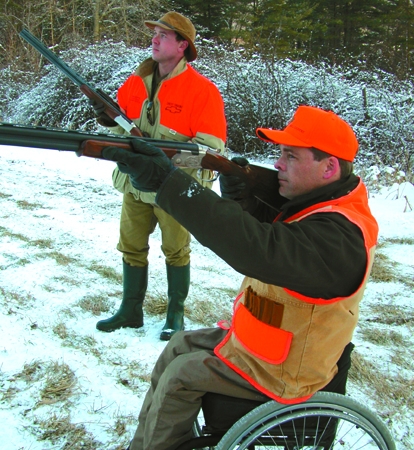
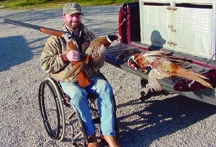
Graham Hill rides a wheelchair to his hunting spots now, rolling out here for a pheasant shoot with friend and ally Chris Cox, Executive Director of NRA-ILA. The confidence and friendship that come from hunting are values he`s promoting in his service with the National Council on Disability. |
||
By John Zent, Editorial Director
You`d think as a Lone Star sage of sorts, Willie would have known better than to write, "Mama, don`t let your babies grow up to be cowboys." Like so many Texans I`ve known, Graham Hill was born a cowboy--and then grew up to pursue another vocation. Trained in the law, Hill`s range today is Capitol Hill in Washington where he serves as counsel to the House Committee on Transportation and Infrastructure, chaired by Representative Don Young (R AK), who`s also a member of the NRA Board of Directors.
But that`s only part of Hill`s Washington workday. Shortly after another Texan arrived for duty in the nation`s capital--President George W. Bush--he appointed Hill to serve on the National Council on Disability. It was a good choice, in that the president not only picked a behind-the-scenes leader he knew he could trust, but also a man who must live with a tough disability himself.
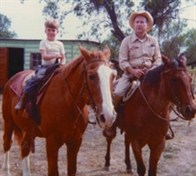
Graham doesn`t get to ride horses anymore because of a tragic auto accident that left him a paraplegic. If you`ve seen family pictures of him literally growing up in the saddle--as I have--you figure that must be a terrible loss. But you sure don`t get that sense from meeting him. The young lawyer is engaged, bright, charismatic, proud. He`s got energy to spare. He`ll talk about his work and dedication to making America a better place, about boyhood adventures in Texas, and especially about how much he loves hunting and the outdoors.
Having to get around in a wheelchair doesn`t keep Graham out of deer stands or duck blinds, or, as I can attest, from joining buddies for a driven pheasant shoot on a bitterly cold winter day. In part this is true because of the remarkable friendships that Graham enjoys. He hunts and shoots with a large group of terrific friends he has had for years, in many cases, even decades. When he talks about hunting, it is always in the context of adventures with his friends and family.
And so despite the fact that the mercury barely hit double digits, Graham and his partners, Chris Cox and David Lehman from NRA`s Institute for Legislative Action, weren`t about to get cheated on a rare afternoon away from the job. Their work often keeps them in the halls of government, where the hours are long and the stakes high--your rights and mine, in fact the freedoms all American gun owners and hunters cherish. But this afternoon was devoted to swinging shotguns and tracking bronze roosters across the midwinter sky. Our group kept at it until sundown, and it was fascinating to watch Graham pivot his chair with one hand while pressing the buttstock to his shoulder with the other. He was so intent on shooting the fast-flying birds he nearly tipped over at times, but never appeared the least bit bothered by the risk. Like all of his hunting partners, Graham has been close friends with Chris and David for years. It is a friendship rooted in a common love of hunting and the outdoors. Graham told me his hunting friends are his closest of all friends because they ignore his disability.
"Chris and David don`t think at all of me as someone in a wheelchair, they think of me as a hunting buddy, and that is because of their character and our experiences together in the outdoors."
Afterward I cornered the cowboy who grew up to be an advocate for outdoorsmen.
AH: Tell us about your work with the National Council on Disability.
Hill: My primary concern is in looking into the biggest obstacles for the disabled. The biggest of all is unemployment. We`re looking at estimates as high as around 75 percent among disabled folks. In my opinion, that`s closely related to transportation and mobility. On some level, disability basically amounts to immobility.
The Clinton administration was working on things that tended not to highlight what disabled folks were capable of doing. I think it is critical for a disabled person to realize they are more capable than they may think, and that they will never know what they can do until they try.
Given the limited resources, a priority should be to empower and inspire. When three-quarters of the 60 million Americans who are disabled are out of work, I am concerned large portions have given up trying. That`s a difference between my approach and the historical approach of only helping the disabled survive, as opposed to succeed. It`s also my goal to advance some of the previous Council`s work on public lands` accessibility to the disabled, particularly for hunting.
AH: Just what is the role of government in providing hunting opportunities for the disabled?
Hill: Current law provides for equal access for the disabled on federal lands, but the question of how well we`re fulfilling that needs follow-up work from the Council. On the positive side, current law has provided disabled veterans access to military reservations and other federal lands. I think that`s an excellent model to follow.
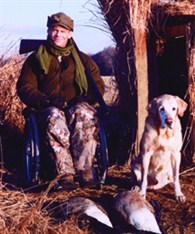
Hill grew up riding horses and hunting with his dad. Despite the accident that left him without the use of his legs, he remains devoted to outdoor pursuits. |
There are problems, however, with what the current law sought to accomplish. Some advocacy groups complain that federal officials are not always keeping open the roads and trails designated for disabled access. In the end, government is not the solution. The solution is bold attitude on the part of the disabled to get out of the rut, and an interest by able-bodied hunters to find a disabled partner.
AH: From someone who is disabled and now has a life in public service, how would you encourage the disabled non-hunter who might be interested in giving it a try?
Hill: That`s where the disabled are very fortunate, because there are a number of exceptional organizations out there that want to reach out and help. NRA has a fabulous outreach program for disabled shooters (see below). Safari Club International has made steps in that direction, and the National Wild Turkey Federation`s Wheelin` Sportsmen is a very sophisticated and effective support group. I think one thing the Council could do is convene a forum to work with groups interested in helping toward the same end, but who often pass each other in the night. If we could get the public and private sectors matched up together, we might see a lot more disabled persons experiencing the outdoors.
AH: How would you advise able-bodied hunters who want to get involved?
Hill: Perhaps what`s missing is an understanding about what a disabled person considers help, and what he considers patronizing. The disabled know the difference when they see it. It`s not just about helping them discover what it means to hunt on a personal level for their achievement, but also to build the friendships that everybody who hunts enjoys. If you want to get involved, just take a disabled friend hunting. When you return, you`ll think of him or her as hunting partner and friend, not a disabled person.
AH: Were you at any point concerned that you would no longer be able to hunt or that it would not be the same fulfilling experience?
Hill: Within a day or two of my car accident in January 1981, I can remember a conversation in the hospital with my parents about going deep sea fishing that summer. For some reason, we all just assumed that nothing was going to be different. We were making plans about going deer hunting that fall. It`s not that they ignored it, it`s that they made a deliberate decision that everything else was going to stay the same. And I believed it. And it did. For some reason I didn`t experience a long period of contemplation about Why me? or What`s this mean?
When I went home from the hospital, nobody from my small town in Texas seemed to think there was anything wrong with me doing everything I had done before, so I didn`t either. We just did it. Still went dove hunting. Still went deer hunting. Believe me, it`s a little different event to climb up into a 10-foot stand from this chair. But just three weeks ago I was back at our place deer hunting morning and evening.
AH: How do you do that?
Hill: I just roll right up to the stand, grab the rail, and take it one hand over another. If my partners don`t think I`m making decent progress they`ll push me up from the rear.
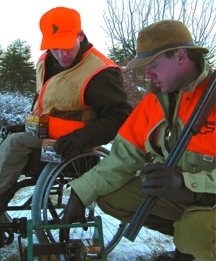
I still hunt with a group of fellows I`ve known for for most of my life, my brother Greg and Cousin Howard. Together we go out, and whatever challenge there may be to a particular place I want to hunt, we come up with an idea. My dear friends Colin Chapman and Mark Malone love to make a place work for me that looked at first impossible; they and I are always dreaming up solutions to terrain challenges. We set up my chair here, move some dirt around, and it works. The self-confidence that comes from this kind of activity is critical for a disabled person. Most importantly, the friendships last a lifetime. Disabled folks too often lose sight of what they can do and can`t do. The fact is, typically, they can do a lot more than they give themselves the chance to do. Building friendships, building confidence, figuring out how to help people help you and how to help yourself--it`s a unique set of ingredients and hunting has them all. There are not many other activities where the disabled can share the same experiences and stories as their friends. Just being in the outdoors has a very powerful effect on a human being. Too few disabled folks get to get out and see a sunset like we saw tonight, to feel the cold wind, to look for birds getting up. They`re experiencing less in life than they were meant to experience. But it doesn`t have to be that way.
NRA Disabled Shooting Services Keeping Them In The Game Hunting and the shooting sports lose more than a quarter-million participants every year due to disabling strokes, diabetes, arthritis, accidental injuries, and a host of other conditions. However, most people who suffer such disabilities don`t lose their desire to remain active, especially sportsmen. With more than 4 million members, it`s no stretch to suggest that many of these folks are NRA`s own. In January 1992, to appropriately field a growing number of shooting sports inquiries from the disabled community, the NRA hired Dave Baskin of Rockledge, Pennsylvania. Baskin brought unique qualifications to the job: He was the head coach of the highly successful United States Wheelchair Shooting Team, and for 33 years he worked for an engineering firm that designed and built critical-care medical machinery. He began work by assisting a wide range of hunters, marksmen, and firearm enthusiasts with specific challenges related to disabilities. But more than members called: state departments of natural resources, law enforcement agencies, and firearm industry representatives also sought Baskin`s advice. In the first year of operation, the service fielded more than 1,000 inquires. It all was overwhelming. So, in 1994, the program became NRA Disabled Shooting Services, a bona fide department within your Association that now handles more than 5,000 requests for guidance every year. As the requests have increased, so has the department`s value. Today, its services encompass almost every type of disability issue related to gun ownership and use. A typical day finds Baskin fielding calls from a father looking for suggestions about hunting rifles for his son born with spina bifida; supplying a hunter ed instructor with tips about working with students in wheelchairs; even relaying contact information to a natural resources officer trying to locate the manufacturer of a mouth-operated trigger mechanism for a crossbow. Sometimes, however, what`s needed is more than a phone call can provide. Baskin also has been known to design a rifle support device for a farmer who lost use of one arm but still wanted to protect his livestock from predators, or explain the rehabilitative benefits of rifle shooting for post-injury patients to a hospital administrator. In just 10 years, Baskin`s service has grown from rather simple roots to become a clearinghouse of information, a valuable resource that serves nearly every facet of hunting and the shooting sports. Better yet, all expertise and guidance is dispensed free of charge thanks to support from The NRA Foundation. Contact NRA Disabled Shooting Services at 703-267-1495, or www.nra.org/compete/disabled.asp.--Eds. |


 More Like This From Around The NRA


