




by CHRIS W. COX
NRA-ILA
Executive Director
The year 2008 could go down as one of the most important years in our lifetime, as far as the Right to Keep and Bear Arms is concerned. In June, the U.S. Supreme Court ruled in District of Columbia v. Heller that the Second Amendment protects an individual right, and that laws banning handguns and prohibiting the use of guns for protection in your home are unconstitutional—a decision that may ultimately have a greater long-term impact on the ownership and use of firearms and ammunition than the Gun Control Act of 1968, the Firearms Owners’ Protection Act of 1986 and the now-expired Clinton Gun Ban of 1994 combined.
But it was at the state level where most of the legislative activity that immediately affects gun owners took place. Many important pro-gun bills were passed, most by overwhelming margins in both houses of the legislatures, and numerous bills that would have restricted our right to arms for defensive, hunting and sporting purposes were defeated.I’d like to go over how these issues played out during the past year, not only to report on our successes and our far fewer setbacks, but also because many of the same issues will be on the front burner in 2009 in many states. No doubt some of them will be taken up by Congress, and there’s no time like the present to start preparing.
Most gun owner victories in 2008 were on issues that directly or indirectly have a major impact on the long-term future of the right to arms for all gun owners and that will be NRA-ILA statewide priorities for some time to come:
• Right-to-Carry improvements and expansions were adopted in Arizona, Florida, Georgia, Kansas, Mississippi, Missouri, Ohio and South Carolina. South Carolina also adopted a law protecting the confidentiality of carry permit holders’ personal information. Forty states now respect the Right to Carry.
• “Castle Doctrine” laws, which affirm the right to respond with force in self-defense and protect victims from lawsuits by criminals or criminals’ families, were adopted in Ohio, West Virginia and Wyoming. Twenty-three states now have such laws.
• “Worker protection” laws, which guarantee the right to leave firearms locked in vehicles in businesses’ parking lots, were adopted in Florida, Georgia and Louisiana.
• “Emergency powers” laws, which prohibit government confiscation of firearms during declared states of emergency, were approved in Kansas, Utah, Wisconsin and Wyoming. Twenty-six states now have this important protection.
• Shooting range protection was improved in Idaho, Mississippi and Missouri. Forty-seven states protect ranges from attempts to close them down due to noise and other such factors. Idaho improved its state preemption of local gun ordinances that are more restrictive than state law.
• Numerous improvements to hunting regulations were adopted, including youth hunting measures in Indiana, Nebraska, New York, South Dakota and Virginia, a pistol hunting expansion in New Hampshire, a cougar hunting provision in Washington, a measure establishing firearm and hunter safety education programs in West Virginia schools, a provision allocating nearly $150,000 for air rifles and marksmanship supplies for rifle teams in Albuquerque, N.M., public schools, as well as hunting preserve and landowner protections in Missouri. Tennessee’s legislature passed a constitutional amendment protecting the right to hunt and fish, which may be confirmed by next year’s legislature and placed on the ballot for approval by the voters in 2010.
While many states passed pro-gun laws this year, several stand out as the battlegrounds where most of our victories were won.
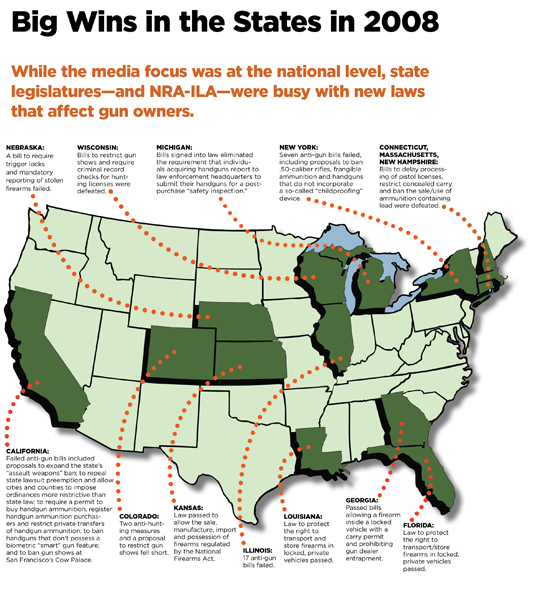
FLORIDA—One of gun owners’ greatest legislative achievements in 2008 was Florida’s passage of “The Pre-servation and Protection of the Right to Keep and Bear Arms in Motor Vehicles Act of 2008,” introduced by Rep. Greg Evers, R. The debate over the law pitted the president of the Unified Sportsmen of Florida—former NRA President Marion P. Hammer—against the Florida Chamber of Commerce. At the end of the day, Hammer and the people won. The bill, signed into law by Gov. Charlie Crist, R, affirms the right of law-abiding Florida gun owners to lock a firearm inside a private motor vehicle in a business’s parking lot, and has already been upheld in federal court.
GEORGIA—House Bill 89, introduced by Rep. Timothy Bearden, R, and signed into law by Gov. Sonny Perdue, R, allows an individual who qualifies for a carry permit to lock a firearm inside a private motor vehicle on a publicly accessible parking lot. The law also prohibits gun dealer entrapment schemes, such as those orchestrated by New York City Mayor Michael Bloomberg, and allows carry permit holders to carry in state parks.
KANSAS—Senate Bill 46, introduced by Sen. Phil Journey, R, and signed into law by Gov. Kathleen Sebelius, D, allows the sale, manufacture, import and possession of firearms regulated by the National Firearms Act.
LOUISIANA—Senate Bill 51, introduced by Sen. Joe McPherson, D, and signed into law by Gov. Bobby Jindal, R, protects the right to transport and store firearms in locked, private motor vehicles and prohibits property owners, tenants, public or private employers and businesses from infringing this right in publicly accessible parking areas.
MICHIGAN—Bills introduced by Senator Randy Richardville, R, and Representatives Paul Opsommer, R, and Joel Sheltrown, D, and signed into law by Gov. Jennifer Granholm, D, eliminates the requirement that individuals acquiring handguns report to law enforcement headquarters to submit their handguns for a post-purchase “safety inspection.” The law—which applied even to brand-new handguns—had been a burden on Michigan gun owners since the 1920s.
MISSOURI—House Bill 2034, introduced by Rep. Brian Munzlinger, R, and signed into law by Gov. Matt Blunt, R, includes shooting range and hunting preserve protections, liability protection for landowners who allow hunting on their land, Right-to-Carry reform, Right-to-Carry permit confidentiality protection and a provision allowing the manufacture, purchase and possession of suppressors.
Regrettably, several misguided bills became law this year in NEW JERSEY. One requires that a person report a lost or stolen firearm within 36 hours after discovery. Yet another prohibits the transfer of handgun ammunition to anyone who does not have a valid New Jersey firearm ID card, or handgun carry or purchase permit, with an exemption for people who purchase ammunition at the range for competition or target practice. Two others—one to limit handgun purchases to one per month and another to increase firearm permit and license fees—are pending at press time.
In most instances, though, the anti-gun agenda ran into a brick wall. In CALIFORNIA, anti-gun bills that failed included proposals to expand the state’s “assault weapons” ban; to repeal state preemption and allow cities and counties to impose ordinances that are more restrictive than state law; to require a permit to buy handgun ammunition, register handgun ammunition purchasers and restrict private transfers of handgun ammunition; to ban handguns that don’t possess a programmable biometric “smart” gun feature to prevent the gun from being fired by anyone other than its authorized user; and to ban gun shows at San Francisco’s Cow Palace. Though California’s legislature approved a bill to increase the training requirement for purchase of a handgun and to limit areas where loaded firearms may be possessed, Gov. Arnold Schwarzenegger, R, vetoed both measures.
Bills to ban ammunition that isn’t “encoded” with a serial number and registered to the purchaser and, in most cases, to require that an individual forfeit his non-serialized ammunition, were soundly defeated in Arizona, Connecticut, Illinois, Mississippi, Missouri, Pennsylvania, Rhode Island, Tennessee and Washington. Our adversaries in Maryland tried a different angle, proposing to prohibit handguns that don’t “micro-stamp” fired cases, but they, too, were unsuccessful.
An “assault weapons” ban was defeated in a House committee in LOUISIANA.
In ILLINOIS, a staggering 17 anti-gun bills failed, including not only the “encoded ammunition” proposal just mentioned, but also bans on ammunition magazines that hold more than 10 rounds, on firearms that have tubular magazines holding more than ten rounds, on countless semi-automatic firearms and on .50-caliber rifles and ammunition. Other bills would have subjected handgun dealers to state regulation, regulated nearly all private sales of firearms, imposed mandatory firearm storage requirements, limited the purchase of handguns to one in a 30-day period and required the provision of a trigger lock with every handgun sold.
Seven anti-gun bills failed in NEW YORK, including proposals to ban .50-caliber rifles, frangible ammunition and handguns that do not incorporate a so-called “childproofing” device or mechanism. Also defeated were bills to expand the state’s “assault weapon” ban, expand its unsuccessful ballistic imaging program, create new requirements and liability for gun dealers and regulate black powder guns as modern firearms.
A CONNECTICUT bill to delay processing of a pistol license, a NEW HAMPSHIRE proposal to restrict the concealed carrying of firearms and MASSACHUSETTS bills aimed at banning the sale and use of ammunition containing lead and at increasing firearm license fees, were all defeated.
In WISCONSIN, bills to restrict gun shows and require criminal record checks for hunting licenses were defeated. In NEBRASKA, a bill to require trigger locks and mandatory reporting of stolen firearms failed. Finally, in COLORADO, two anti-hunting measures and a proposal that could have hurt gun shows by allowing the Colorado Bureau of Investigation to stop conducting instant checks on Sundays fell short.
As you can see, supporters and opponents of the right to arms were engaged in many states, on many issues, in the past year. And, I’m happy to report, virtually all of the legislative victories in the states in 2008 were ours. If we work together during the states’ next legislative sessions, we can maintain our winning momentum toward the complete validation and vindication of the most important of our individual rights.


 More Like This From Around The NRA


